


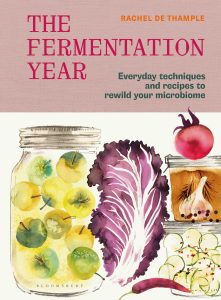
The advantage of eating fermented foods is now a well known fact and this week sees the publication of a great new guide to using seasonal fermentation to rewild your microbiome. The Fermentation Year, is by Rachel de Thample and published by Bloomsbury at £22 for a lovely hardback.
Rachel de Thample

Rachel is the award-winning author of seven books, including Tonics & Teas, the River Cottage Fermentation Handbook, which won a Guild of Food Writer’s Award, and Guild of Food Writers Awards Food Book Award finalist Winter Wellness. She has worked in food, health and sustainability for more than 20 years, served as Course Director of the College of Naturopathic Medicine’s Natural Chef diploma course in London, and was Commissioning Editor of Waitrose Food Illustrated magazine.
She teaches fermentation and seasonal nutrition courses at River Cottage in Devon, as well as Petersham Nurseries and Daylesford.
The Book
Seasonally structured, it covers everything you need to know about fermenting at home all year round, including basic techniques for kimchi, kefir (water and dairy), sauerkraut, pickles, fermented sauces, honey ferments, miso, kombucha, vinegar and yoghurt. Each has opportunities for seasonal twists, and there are plenty of delicious recipes for every day fermented dishes, such as Korean-style kimchi pancakes, Slow roast lamb with honey fermented rhubarb, and Strawberry top and black pepper kombucha. It will help you cherish the edible calendar and preserve the best of the season, while also avoiding waste and boosting flavour.
The act of making these delicious foods is a tonic within itself, making you feel more alive in every possible way as you harness the invisible life around you.
Here are a few recipes from the book to inspire you:
MISO FERMENTED ONIONS
“Called misozuke, these onions are a Japanese-style pickle fermented in miso. Not only do you get the perks of a pickle that’s rich in protein and probiotics, but you also receive all the benefits of raw veg, as this is a completely raw pickle, softened in just a short whisper of time. The resulting miso-fermented alliums take on all the salty umami deliciousness of anchovies (as described by my amazing friend Emma Chase, who inspired this recipe), yet retain the immune-boosting properties of raw onions, which are also a source of the prebiotic fibre that your microbes turn into valuable butyrate.”
MAKES 300G 
100g miso (homemade or unpasteurised)
2 tablespoons rice wine vinegar, sake, or lime juice
1 garlic clove, finely chopped Pinch of chilli flakes
1 large onion (red onions are best, as they’re richer in antioxidants)
5 bay leaves
YOU WILL NEED
500g shallow jar or dish with airtight lid
FERMENTING TIME
3 days
Put all the ingredients apart from the onion and bay leaves into a 500g shallow jar or dish with an airtight lid. Mix well. Thinly slice the onion and fold through the miso mix.
Cover with a lid and ferment at room temperature for 3 days, then place a few overlapping bay leaves over the top to fully cover and keep in the fridge for up to 3 months.
The onion slices make a wonderful condiment for almost anything, but especially for East Asian foods, or as a topping for flatbreads. Use the leftover marinade as you would regular miso paste, to make an onion-accented soup, or to add flavour and depth to other dishes.
BLACK GARLIC MISO MARMITE
“Black garlic is not a special variety of the allium, rather it’s created by slowly ageing regular garlic bulbs, effectively fermenting them by cooking for up to ninety days in a humidity-controlled environment at a low temperature. During the process, the enzymes that give fresh garlic its sharpness break down and so the cloves are transformed into sticky, date-like black nuggets rich in antioxidants. They also contain a compound called S-allyl cysteine, which has antioxidant and neuroprotective properties.
“Here, I’ve harnessed the deep umami-rich flavour notes to create a yeast extract of sorts. Muddling the black garlic cloves into a paste with a little salt makes a magical spread for buttered toast, or a flavour-enriching condiment which also adds a health boost to any dish.”
SERVES 2 –4
1 black garlic bulb, or small pot of peeled black garlic cloves
1 teaspoon miso (homemade or unpasteurised), or to taste
Squeeze of lemon juice Sea salt (optional)
Peel your black garlic cloves if they’re not peeled already.
Mash into a paste in a bowl with the miso and lemon juice, to bring it together. You can do this in a blender, on a board with the side of a wide knife blade, or in a mortar and pestle. Taste and add a pinch of salt or more miso or lemon juice, if needed.
Use straight away, or spoon into a small jar. It will keep happily in the fridge for a month.
KEFIR GELATO
“What I love about gelato as opposed to ice cream is its softer texture. Swapping the milk in a regular gelato recipe for dairy kefir – which essentially is just cultured milk – and using honey in place of sugar, offers a similar, easy-to-scoop, melts-on-your-tongue texture which makes it oh-so-easy to devour. I absolutely love this recipe and the joy is that you get to play around with different summer fruit flavours. Mango is not a fruit local to where I live, but if it is for you, give it a go.
“A man once told me that his native mangos were so celebrated that local schools took a holiday break specifically for mango season, allowing children to be fully devoted to devouring the bounty.”
SERVES 4
200g ripe mango flesh, nectarines, peaches or apricots
200g dairy kefir, or yogurt 50g honey, or maple syrup
Simply blend all the ingredients together. Pour into a shallow freezer-proof dish and freeze for at least 4 hours, or until firm.
Scoop out and eat straight away
Extract taken from The Fermentation Year by Rachel de Thample (Bloomsbury Publishing, Hardback, £22). Photography © Patricia Niven.

